🔷 A Journey Through Time at La Crucca: Experience a Day as a Roman Legionary in Sardinia
Have you ever dreamed of travelling back in time? Perhaps to find yourself among the ranks of Roman legions, inside a real fort, immersed in the daily life of antiquity.
In north-western Sardinia, just a few kilometres from Sassari, the La Crucca Roman Castrum Park awaits you—the first and only faithful reconstruction of a Roman castrum in Italy from the 1st and 2nd centuries AD, dating back 2000 years. A surprising place where history, nature, and adventure blend to offer an unforgettable experience for both young and old.
The Castrum, as you see it, is the result of the Castrum Romano Association, born from a passion for ancient Rome. The association operates in the field of historical reenactment and organises annual historical, cultural, playful, and recreational activities in the park surrounding the Roman fort of La Crucca.
Centurion Massimiliano Schirru, of the Sardinian unit of Cohors I Nurritanorum
🔷 THE CASTRUM: AS IT WAS 2000 YEARS AGO
The Roman castrum (plural: castra) was the fortification that Roman legionaries built during their conquest campaigns. Inside, there were various buildings serving as soldiers' quarters, the commander's residence, workshops, stables, warehouses, latrines, etc. It was a self-sufficient military citadel ensuring that soldiers could live safely during their campaigns to conquer new territories. After the conquest, the castrum became the centre from which Roman authority and civilisation spread—a legacy that still influences us today. castra. The Roman castrum (plural: castra) was the fortification that Roman legionaries built during their conquest campaigns. Inside, there were various buildings serving as soldiers' quarters, the commander's residence, workshops, stables, warehouses, latrines, etc. It was a self-sufficient military citadel ensuring that soldiers could live safely during their campaigns to conquer new territories. After the conquest, the castrum became the centre from which Roman authority and civilisation spread—a legacy that still influences us today. (Learn more).
At the Roman Castrum Park, you can closely explore:
The legionaries' dormitories, furnished with beds and everyday objects
The commander's residence
The armoury and infirmary
The kitchen and bread oven
The blacksmith's workshop
The tower with the ballista, an imposing siege weapon
A diorama room that narrates military life with models and historical reconstructions.
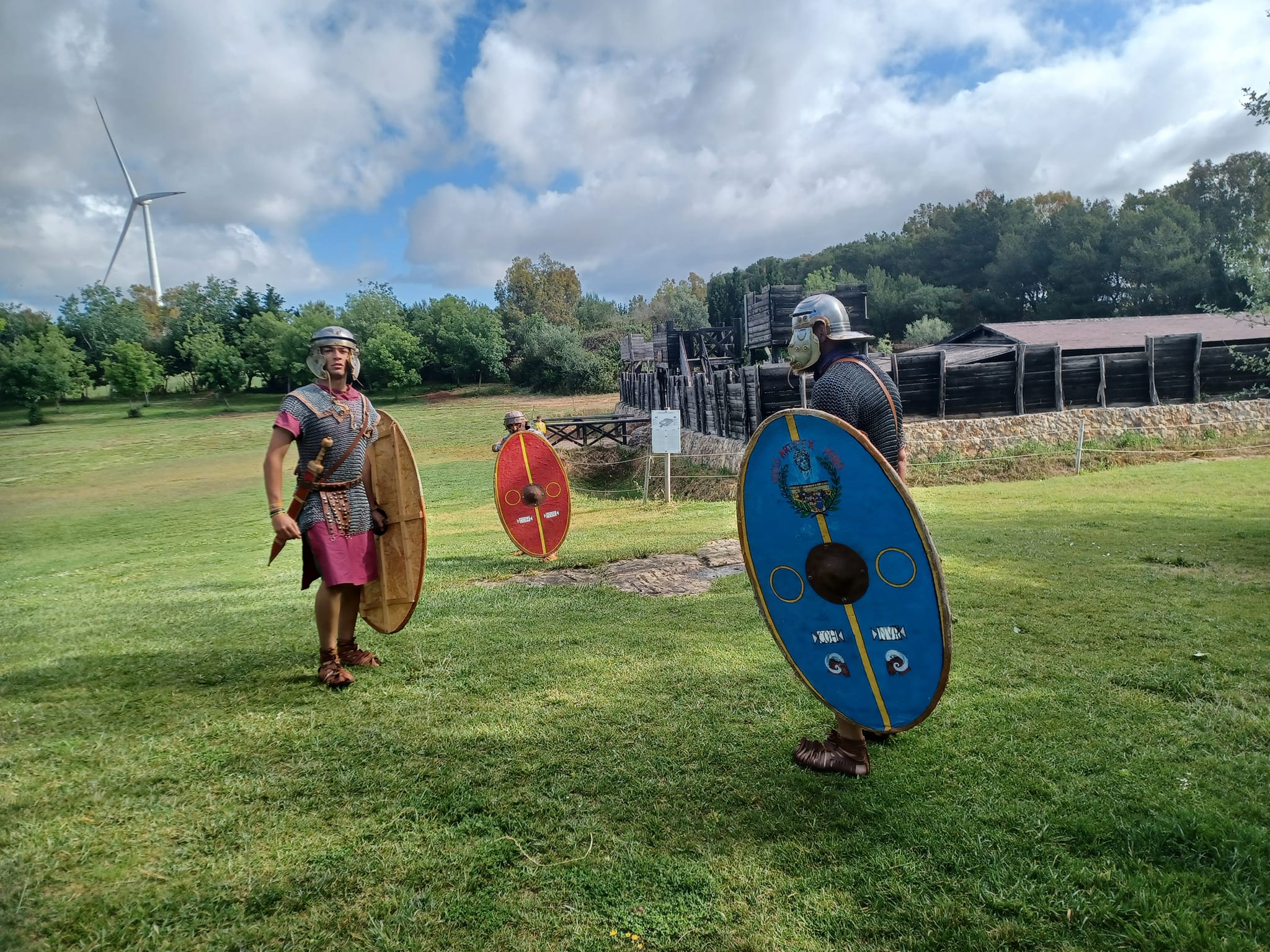
Within the Roman Castrum, you can have an unforgettable experience for all ages, spending a different day outdoors and perhaps meeting the legionaries of the Cohors I Nurritanorum, a Sardinian unit composed of Sardinian soldiers, which is the historical reenactment group from Sassari that animates the Castrum on special occasions.
The Roman Castrum surrounded by the green lawn of the park
🔷 NEW FOR 2026: THE SARDINIAN VILLAGE OF THE "SARDI PELLITI"
Opposite the faithful reconstruction of the Roman Castrum, symbol of Rome's military organisation, in 2026 the Park will introduce a new immersive area dedicated to the Sardinian communities of the interior, traditionally referred to in Roman sources as 'Sardi Pelliti'.
The term pelliti literally means “clothed in skins” and appears in the writings of Latin authors such as Titus Livius and Marcus Tullius Cicero.
However, it did not refer to a people with this name, but was an expression used by the Romans to describe the communities of inland Sardinia which, during the Roman domination of the province of Sardinia et Corsica, maintained their traditions and relative cultural autonomy for longer.
In particular, the mountainous areas that the Romans called Barbaria (now Barbagia) were considered difficult to control and less integrated into the Roman urban system than coastal cities such as Karalis or Tharros.
The Village does not therefore represent a 'mysterious people', but rather reconstructs the life of the indigenous Sardinian communities of the Roman era in an educational way: sheep farming, simple dwellings, tribal organisation and traditions rooted in Nuragic civilisation.
🔷 A PARK BETWEEN HISTORY AND NATURE
The Castrum is immersed in a large private green park: a true haven of peace among trees, ponds, natural springs, and wide meadows. You'll find:
A children's play area
A small bar and picnic area with barbecue, tables, and benches
Toilet facilities (including for disabled visitors)
Free parking, spacious and also accessible to coaches
An ideal place to spend a day outdoors with family, combining relaxation and discovery.
🔷 THE EDUCATIONAL FARM
Inside the park, there's also a meticulously maintained educational farm, with many animal species to observe and get to know up close: llamas, emus, alpacas, horses, Vietnamese piglets, Tibetan goats, peacocks, turkeys, and many others. Perfect for children and school groups; it's an opportunity to learn respect and love for nature through interaction with animals.
Tibetan goats at the Castrum Romano Park educational farm
🔷 OPENING HOURS
👉 22 March – 31 October
✅ Every day from 10:00 at 18:00
🔸 Closed on Tuesdays
👉 November – December
✅ Saturday and Sunday at 10:00 – 17:00
👉 January – March
✅ Closed for maintenance
🔷 ACTIVITIES FOR SCHOOLS AND FAMILIES
The park offers educational and recreational activities from March to November, designed for different age groups:
✅ For nursery schools:
visit to the farm;
honey workshop;
direct contact with animals in the enclosures.
✅ For primary, middle, and university students:
meetings with the legionaries of the Cohors I Nurritanorum;
workshops on Roman military tactics;
role-playing games, interactive activities, and simulations;
immersive experiences to "live" life in the Castrum.
The boys and girls will have a unique and unforgettable experience learning interesting facts about Roman history: what architecture looked like, how the land was measured, what people ate, how they played, what customs were... in short, they will return home knowing that they have lived like a real Roman soldier.
Throughout the day, they will be able to enjoy unique experiences designed especially for them, where they will have the opportunity to learn by playing! Lots of physical activity in the open air where they will be able to try their hand for a few hours in the role of legionaries and auxiliary soldiers, using military formations such as the tortoise and the shield wall, simulating battles and sieges at the castrum. They will also deepen their knowledge of Roman history through role-playing games and educational workshops.
So what an opportunity to embark on an exciting
journey back in time into Roman civilisation, seen not only from a military aspect, but also from a civil one!
🔷 PARTIES, EVENTS AND FREEDOM
The Park is also the ideal place for:
birthday parties;
historical or fantasy-themed events;
days among friends with animals in tow (they are welcome!);
bike explorations along park trails.
Historical reconstruction of a battle between Romans and barbarians
🔷 ADMISSION PRICES
Visit Castrum, Sardinian Village and Educational Farm + stay inside the Park:
👉 Adults, €15.00;
👉 Children aged 3 to 10 years old, €10.00 – free for children under 3 years old.
Per fornire le migliori esperienze, utilizziamo tecnologie come i cookie per memorizzare e/o accedere alle informazioni del dispositivo. Il consenso a queste tecnologie ci permetterà di elaborare dati come il comportamento di navigazione o ID unici su questo sito. Non acconsentire o ritirare il consenso può influire negativamente su alcune caratteristiche e funzioni.
Funzionale
Always active
L'archiviazione tecnica o l'accesso sono strettamente necessari al fine legittimo di consentire l'uso di un servizio specifico esplicitamente richiesto dall'abbonato o dall'utente, o al solo scopo di effettuare la trasmissione di una comunicazione su una rete di comunicazione elettronica.
Preferenze
L'archiviazione tecnica o l'accesso sono necessari per lo scopo legittimo di memorizzare le preferenze che non sono richieste dall'abbonato o dall'utente.
Statistiche
L'archiviazione tecnica o l'accesso che viene utilizzato esclusivamente per scopi statistici.L'archiviazione tecnica o l'accesso che viene utilizzato esclusivamente per scopi statistici anonimi. Senza un mandato di comparizione, una conformità volontaria da parte del vostro Fornitore di Servizi Internet, o ulteriori registrazioni da parte di terzi, le informazioni memorizzate o recuperate per questo scopo da sole non possono di solito essere utilizzate per l'identificazione.
Marketing
L'archiviazione tecnica o l'accesso sono necessari per creare profili di utenti per inviare pubblicità, o per tracciare l'utente su un sito web o su diversi siti web per scopi di marketing simili.
 English (UK)
  Italiano