 English (UK)
  Italiano


Italian cutlery: roots and traditions.
In Italy, the production of knives was already widespread in every region, as far back as the 13th century. With the passage of time, each region has retained its own distinct identity in the manufacture of knives, as well as the different types that arose in relation to local needs and cultural characteristics. In fact, one finds within the same region, different types of models linked to their place of origin.
In Sardinia, we find in Guspini the leppa guspinesa, in Arbus the arburesa, in Pattada the pattadesa, in Santu Lussurgiu the leppa lussurgese.
However, Dorgali, Gavoi and Bonorva also had a production of fine knives.
Knife production in Italy between the 18th and 19th centuries.
Knife production in Italy in the 18th century was considerable, and the most common model was the folding knife, serramanico with a blade that could be folded inside. Then, starting in the 19th century, production began to decline gradually for two main reasons:
- the first due to restrictive laws that began to prohibit the free carrying of knives, in order to curb the numerous violent incidents that were widespread throughout Italy;
- The second factor, on the other hand, was caused by the exponential increase in competition from foreign production, especially from Germany and Switzerland, which were more industrially advanced and innovative and able to replace most local production.
Origins and spread of the Sardinian knife.
The history of Sardinian cutlery has ancient origins, but the first reliable sources relating to the presence of folding knives date back to the first half of the 1800s. Before that time, there were larger fixed-blade knives, halfway between a sabre and a dagger, known as “leppa”, the “daga” and the “stillu”, typical of Sardinian shepherds who used to carry them tucked into their belts.

The gradual replacement of the fixed-blade knife with the switchblade model took place from the first half of the 19th century, presumably due to the need for greater convenience and safety during transport. The knife was generally stored in the saddlebag along with the foodstuffs that the shepherd carried with him: bread, cheese and sausage.
The knife in the daily life of shepherds.
Generally, shepherds used to carry two or three different types depending on the type of work to be done, such as cheese making, slaughtering, wood and cork working, and other agricultural activities, such as cutting vegetables.
The knife was an important and fundamental tool for the needs of life in those days, an object so important that the shepherd had to turn to real specialists for its production: in fact, it was one of the few tools that he was unable to make himself.
Sardinian blacksmiths: masters and guardians of tradition.
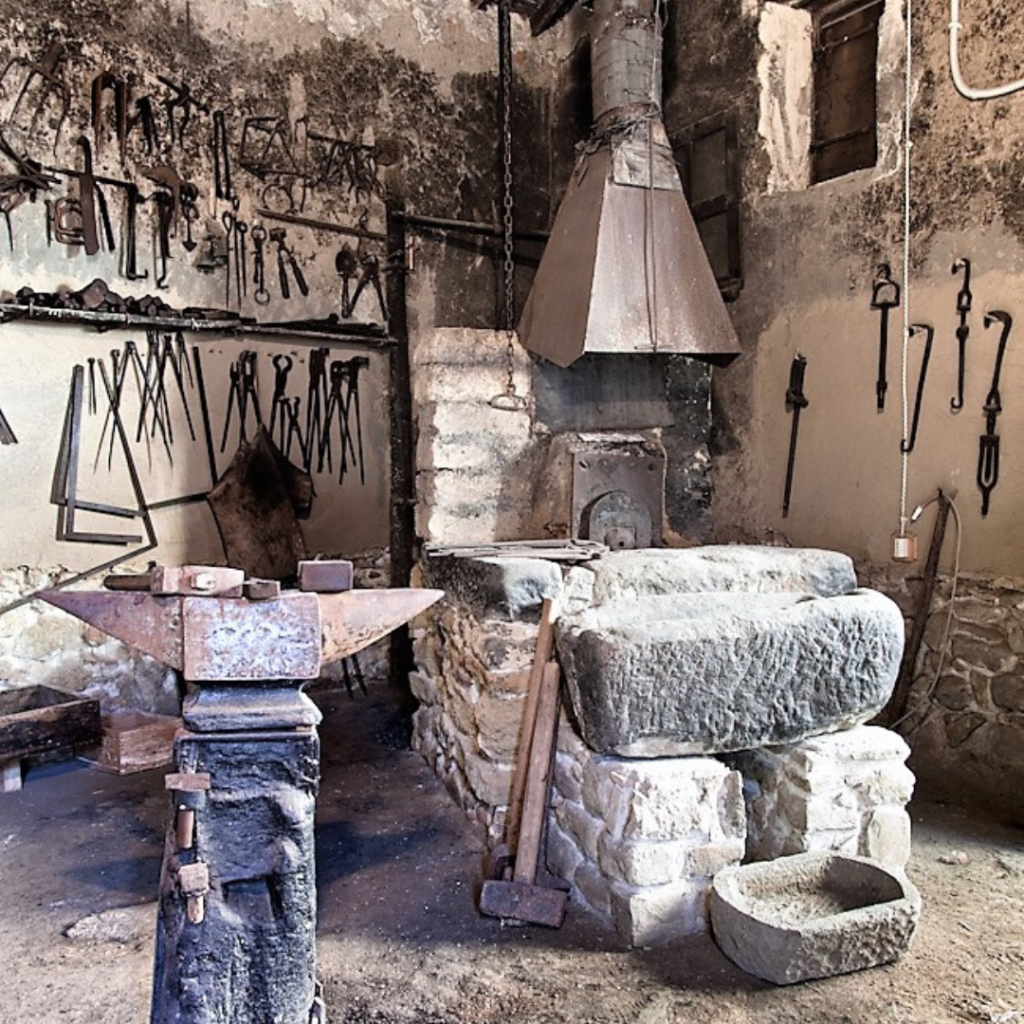
The specialists who produced knives were almost always blacksmiths (ferreri in Sardinian) and their craft played a fundamental role in the social and cultural life of small Sardinian towns. In fact, the ferreri's workshop was a place for socialising, and his skill in working with iron was indispensable for repairing work tools such as scissors, cutlery, billhooks, spades, horseshoes and ox shoes, etc.
To emphasise their prestige, there are some historical documents, found in Pattada, which state that blacksmiths, in particular historical circumstances, were exempt from paying feudal dues. Their art was handed down from father to son and from generation to generation.
From the post-war period to tourism: the transformation of the Sardinian knife.
The technological changes gradually introduced on the island starting in the second half of the 1900s and the subsequent lack of interest among younger generations in pursuing this trade have diminished the role of the blacksmith, separating knife production from the blacksmith's workshop and giving rise to new business model.
However, it should be noted that, unlike other national productions, Sardinian cutlery has retained a high degree of manual skill in the production process, partly due to the absence on the regional market of machines specifically designed for knife-making.
A revolution in knife production began in the 1950s, when economic prosperity, increased per capita wealth and the resulting change in lifestyles, combined with the gradual influx of tourists that characterised the island from the 1960s onwards, transformed the knife:
from an indispensable tool for everyday life to a souvenir of Sardinia and a highly sought-after item by collectors and lovers of artistic products.
The main types of Sardinian knives.
Còrrina
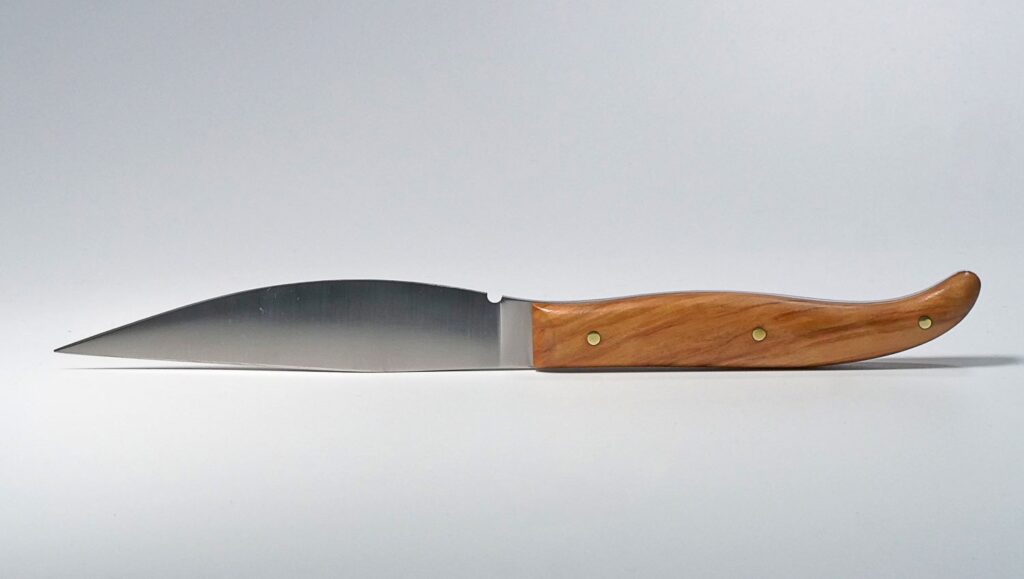
This is a rather rustic and simple fixed-blade knife (those of the first generation). It consists of a so-called 'olive leaf' blade simply attached with several pins to a goat or mutton horn handle, without the use of any ring at the blade's junction. Precisely because of its simplicity of construction, this knife was often made by the shepherd himself, who usually used an old saw blade from which he removed the half-worn notches, which he then sharpened with the help of an abrasive stone, then attached it with a riveted nail to the previously pierced horn.
Arburesa

It is a switchblade with a forged blade in the shape of a 'broad leaf', pot-bellied: it is ideal for skinning animals or in hunting practice. Its handle is often fashioned from goat's horn; it has an arched shape that follows the line of the blade's edge. In more recent models it has been enriched with two brass rings: one positioned at the height of the rivet and the other in the heel of the handle.
Guspinesa

It is a switchblade knife made in two models: the first has a slightly curved blade, also known as a 'myrtle leaf' (foll'e murta), and a somewhat curved handle; the second model, on the other hand, known as a 'spatula', differs from the first by its truncated blade and the particularly square shape of the handle, which symmetrically echoes that of the blade.

The truncated blade guspinesa dates back to 1908 when, following the publication of the Giolitti Law, it was forbidden for anyone to carry sharp knives 'without justified reason'.
PATTADESA
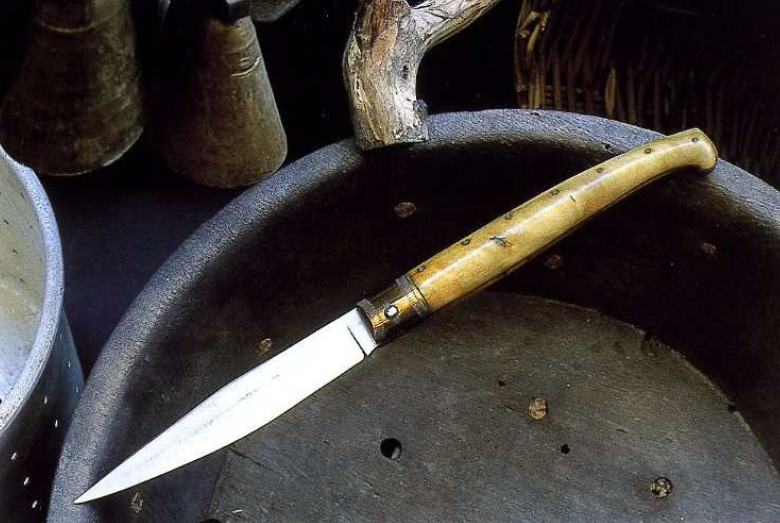
In this knife, the handle is no longer composed of a horn monobloc, but of two strips that are joined by rivets and incorporate 's'arcu', the bow, a metal element that makes the handle much more robust and practically non-deformable.
Musei del coltello in Sardegna.
There are two private Museums on the Knife in Sardinia, one is in Pattada: the Culter International Museum of the Knife, run by the Giagu family of knife-makers, and the other is in Arbus: The Museum of the Sardinian Knife, created and run by the knife-maker Paolo Pusceddu.
Bibliographic references.
- Giulio Angioi, I pascoli erranti. Antropologia del pastore in Sardegna. – Ed. Liguori, 1989;
- Disciplinare di Produzione coltello artigiano – Sardegna, della Regione Autonoma della Sardegna;
- P. Gometz, “Coltelli di Sardegna. Strumenti, simboli e leggende d’una antica civiltà” – Edizioni Della Torre (2002);