 English (UK)
  Italiano


What happens when we view Nuragic Sardinia not as a collection of isolated monuments, but as a network of interconnected sites?
This is the question raised in the article published by Stefano Sanna on the Maimoni Blog, which stems from an examination of possible connections between the Mont’e Prama site and the Mont’e Palla profile, offering an interpretation that weaves together landscape, orientation and symbolism
It is a fascinating theory: some of the most significant sites of Nuragic civilisation may have been conceived within a broader symbolic landscape, in which mountains, monuments and astronomical phenomena interacted with one another.
This is a theory that naturally requires further study and scientific verification, but it offers an interesting starting point for reflecting on how the island’s ancient inhabitants perceived the landscape around them.
To gain a better understanding of this proposal, we must begin with Mont’e Prama, the archaeological site that has revolutionised our understanding of Nuragic Sardinia over the past few decades.
Mont’e Prama: the site that changed the history of Nuragic Sardinia
When the first fragments of the Mont’e Prama statues were unearthed in 1974, no one could have imagined the significance of the discovery.
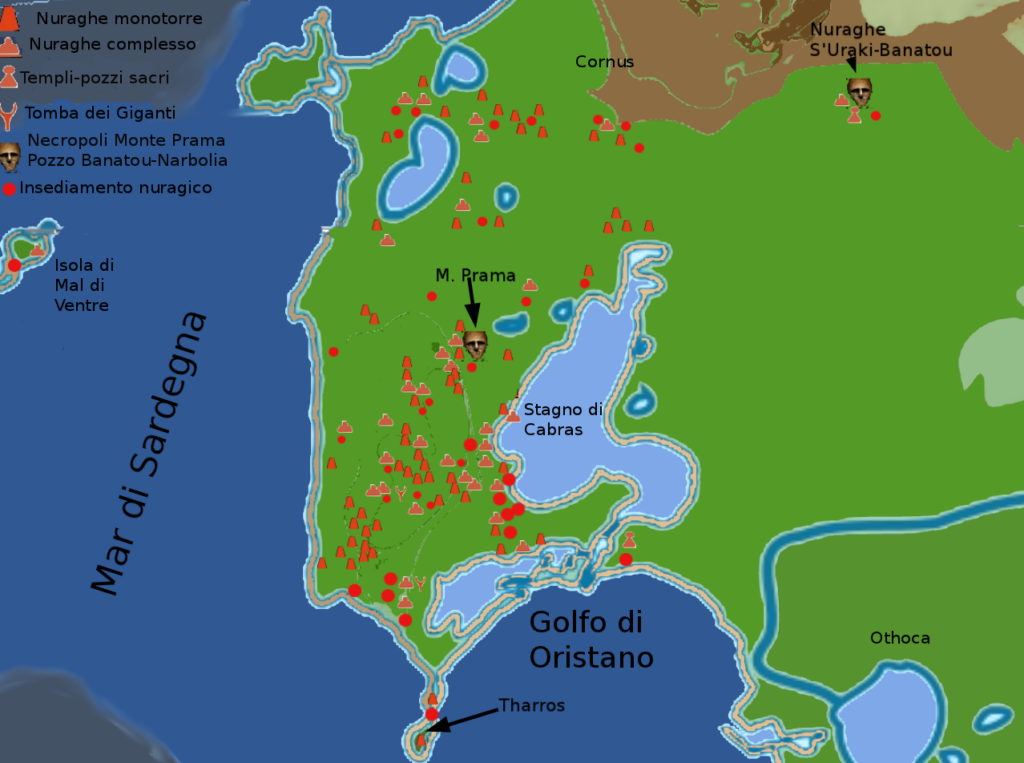
In the heart of Sinis, a few kilometres from Cabras, a monumental complex was discovered that is unrivalled in the western Mediterranean of the Iron Age. Warriors, archers and boxers carved in stone revealed a Sardinia that was far more complex, organised and culturally advanced than had previously been thought.
Even today, Mont’e Prama continues to raise questions.
Why that particular place?
What significance did it hold for the Nuragic communities?
And what was the relationship between the statue complex and the surrounding area?
These are questions that archaeologists and scholars are still trying to answer.
Stefano Sanna’s thoughts
In his recent article, Stefano Sanna encourages us to look at the landscape in a different light.
According to the author, certain geographical features of central-western Sardinia may not simply be unrelated natural elements, but rather parts of a more complex symbolic system.
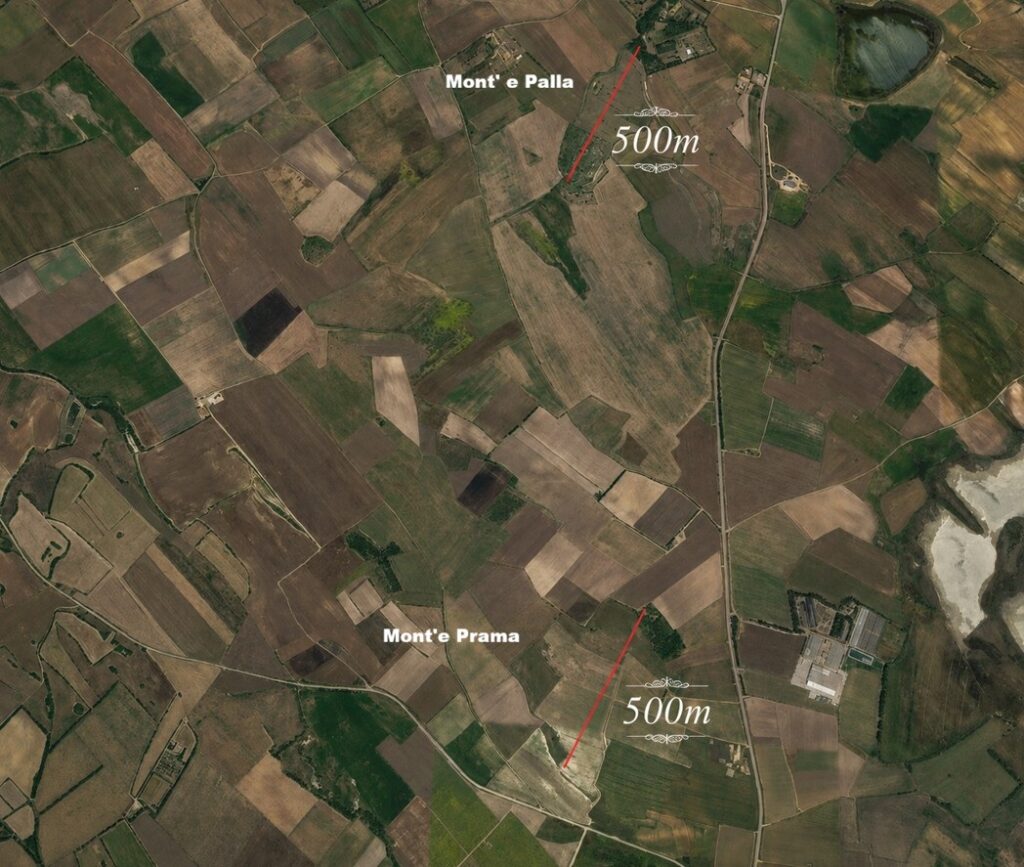
The focus is particularly on the relationship between Mont’e Prama and Mont’e Palla, one of the most significant peaks of the Montiferru range, exploring possible links related to the orientation of the landscape and the observation of the sky.
This article does not claim to provide definitive answers, but offers an interpretative framework designed to stimulate debate and encourage the exploration of new avenues of research.
Was Sardinia in the Nuragic period a sacred landscape?
The idea that ancient peoples attributed symbolic significance to mountains, springs, hilltops and vantage points is by no means unfamiliar to archaeological studies.
In many Mediterranean civilisations, the landscape was not seen merely as a backdrop to daily life, but as an integral part of the religious and cultural world.
In Sardinia, too, there are numerous examples that suggest a deep connection between monuments and the local area.
Nuraghi built on commanding heights, giants’ tombs arranged in recurring patterns, and sanctuaries associated with springs and watercourses bear witness to a complex relationship between humans and the environment.
From this perspective, the suggestion that Mont’e Prama might form part of a wider symbolic landscape seems, at the very least, worthy of consideration.
Archaeoastronomy and landscape archaeology
To understand the significance of these interpretations, it is useful to consider two disciplines that are becoming increasingly prominent in contemporary research: archaeoastronomy and landscape archaeology.
The first, archaeoastronomy, studies the relationship between ancient civilisations and the observation of celestial phenomena.
The second, The Archaeology of Passage, examines the ways in which humans have organised and attributed meaning to the spaces they inhabited.
Over the past few decades, both have helped to move beyond the notion of the isolated monument, promoting a broader and more dynamic understanding of archaeological contexts.
However, it is important to remember that identifying a possible geographical or astronomical alignment does not automatically prove that it was intentional.
For this reason, scholars always call for topographical, archaeological and statistical verification before accepting a particular interpretation as confirmed.
An invitation to see Sardinia in a new light
Setting aside individual theories, Stefano Sanna’s contribution has the merit of bringing a fascinating question back into focus: how did the Nuragic people view the world?
Did the mountains we now regard as mere features of the landscape perhaps once hold a special significance?
Were these great monumental works linked by a logic that we still do not fully understand?
Or are we only just beginning to grasp the complexity of a civilisation which, despite decades of study, continues to harbour many of its secrets?
These are questions that are likely to continue to feature in the scientific debate for some time to come.
Meanwhile, reflections such as those put forward by Stefano Sanna remind us that Sardinia is not merely an island rich in extraordinary monuments, but an immense cultural landscape that has yet to be fully unravelled.
And it is perhaps precisely in this ability to raise new questions that the true charm of Mont’e Prama lies.
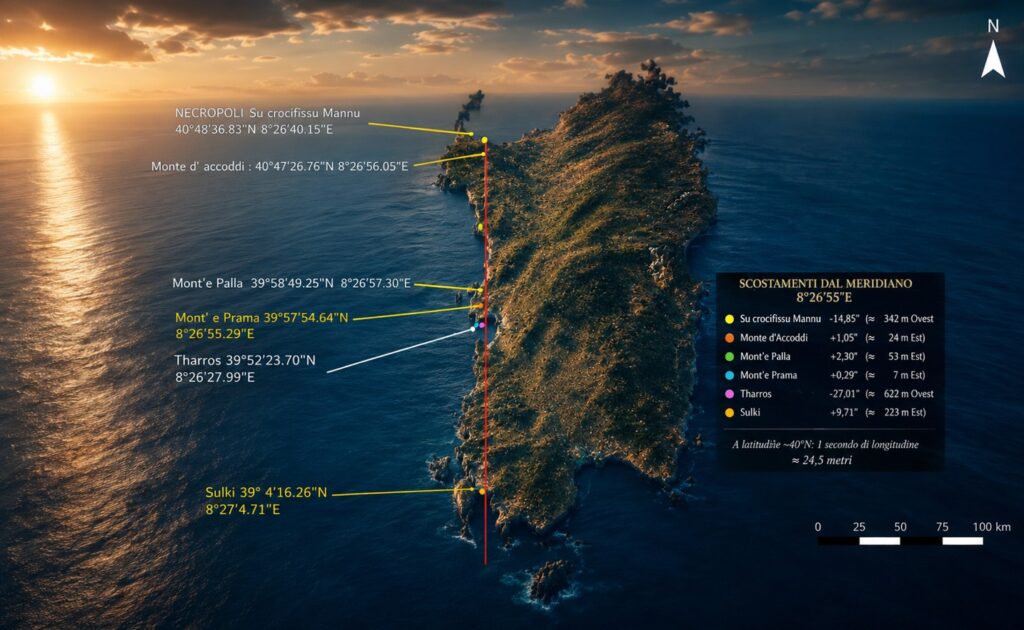
The hypotheses discussed in this article offer an interpretative framework and provide food for thought on the relationship between the Nuragic people and their territory. Archaeological research continues to yield new findings for study and analysis, helping to enrich our understanding of Sardinia’s history.
Find out more:
🔶 Original article by Stefano Sanna on the Maimoni Blog
🔶 See also: Cabras e il Sinis: storia, mare e archeologia
🔶 See also: Domus de Janas, a UNESCO World Heritage Site
🔶 Further reading: Mont’e Prama and the Stone Giants of Sardinia
🔶 See also: Sardinia: myths and legends of the Janas, Giants and mysterious menhirs
AI Disclosure (AI Act 2025 – Italian Law 132/2025):
the text content is AI-assisted, created by Antonio Casu with the support of ChatGPT (GPT-5.2), OpenAI, in accordance with the transparency principles set out in Regulation (EU) 2024/1689.