 English (UK)
  Italiano

Every 30th of November the squares and narrow streets of some Sardinian villages come alive with lanterns made from carved pumpkins and the opening of wine cellars: it is the festival of Sant’Andrìa, an occasion that combines protection, conviviality and remembrance. This article reconstructs the origins, practices and variations of the festival, providing ideas for those who want to experience it first-hand or learn more about the subject.
Sant’Andrìa: Christian saint or echo of ancient cults?
Formally, the anniversary coincides with the feast of St. Andrew the Apostle (30th November) and in popular parlance many communities call the month of November 'Sant'Andrìa'. The spirit of the festival, however, is rooted in the farming practices of the autumn cycle: the opening of the barrels and the tasting of new wine, propitiatory rites linked to the harvest and the protection of the community.
Numerous folklore studies highlight how the figure of the saint has been superimposed on pre-existing popular practices, with similarities to the Dionysian cults associated with wine.
One of the most fascinating interpretations is that of linguist Salvatore Dedola, according to whom the name Sant’Andrìa is the result of a paronomasia: a linguistic game that originated in the Byzantine era to facilitate the transition from paganism to Christianity.
According to Dedola, 'Andrìa' does not originally derive from the name of the apostle Andrew, but from a Sardinian compound with roots in ancient Sumerian, translatable as 'sky' + 'to immerse, to soak'.
November would thus be the month when "the sky drenches the earth", a perfect image of the Sardinian autumn climate: the newly sown fields are nourished by the first rains, symbolically opening the new agricultural cycle.
The anthropological interpretation: Saint Andrew as the counterpart of Dionysus
Another interpretation, proposed by anthropologist Dolores Turchi, directly links Saint Andrew to Dionysian cults. According to Turchi, November in ancient times was dedicated to Dionysus, god of the vine, intoxication and regeneration. It is no coincidence, she writes:
The entire month of November was dedicated to Dionysus...
In Galtellì, Sant'Andria is known as su santu ‘e su vinu…
because that is the month when the barrels are opened.
From this perspective, Christian saints would have inherited more ancient symbolic functions: protecting the harvest, accompanying new wine, presiding over the community during the transition from autumn to winter.
Pumpkins: ritual, function and local variations
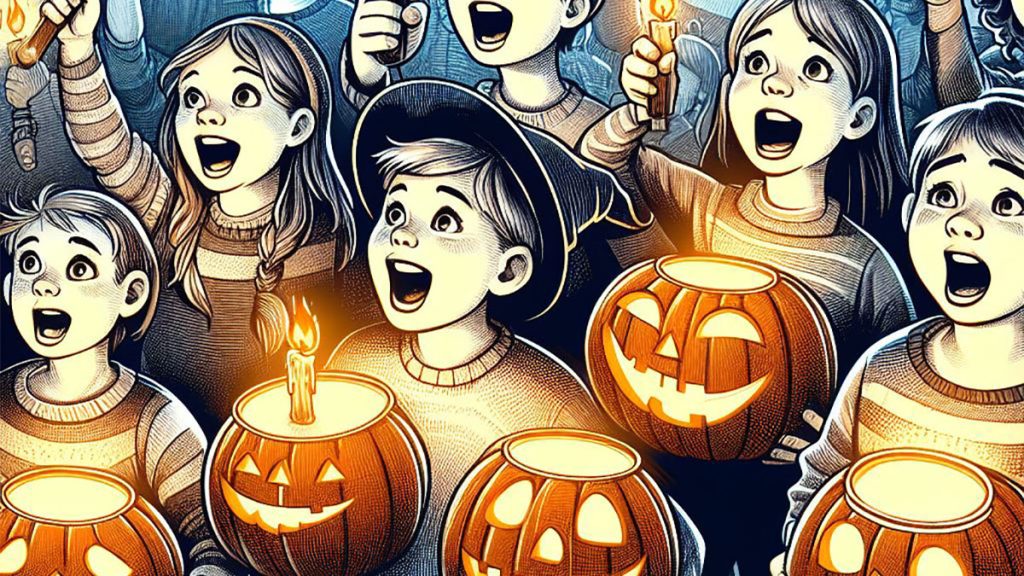
The procession of carved pumpkins is the most evocative event, documented in villages such as Bono and Martis. The pumpkins are hollowed out and lit from within; children carry them around the village, knocking on doors and collecting offerings — sweets, nuts or a few coins. The ritual retains apotropaic features (keeping spirits away) but also has a social function of exchange and solidarity. Some folkloric sources also mention other Sardinian towns as having been linked in the past to the feast of Sant'Andrìa, but the most vivid, documented and still practised examples remain those of Bono and Martis.
New wine: tapping and conviviality
The Dionysian dimension – or more simply, the peasant dimension – is very evident in centres such as Ozieri and Bono.
In Ozieri, during Su Trinta 'e Sant'Andrìa, the entire town is transformed into one big party:
- the wine cellars in the historic centre open to the public
- you can taste the new wine from local vineyards
- typical dishes prepared for the occasion are offered
- community rituals linked to the arrival of winter are celebrated
A true celebration of the region that keeps alive the ancient tradition of tapping barrels.

In Bono, the procession of carved pumpkins – which evokes the relationship with the deceased – is accompanied by almsgiving and the distribution of new wine and roasted chestnuts, thus combining spiritual, seasonal and convivial elements.
In this intertwining of Christian rituals, agricultural symbols, community practices and possible pagan echoes, Sant'Andrìa continues to represent one of the most evocative moments of the Sardinian autumn, in which the island's rural past resurfaces with force through simple gestures laden with meaning.

Folkloric interpretations and critical notes
The reconstructions are mainly ethnographic and comparative: there is talk of syncretism between Christian worship and agricultural rites. Although similarities can be found with wine traditions from different periods, it should be remembered that there is no direct archaeological evidence linking modern practices to Nuragic rituals in an unbroken chain; many interpretations are based on historical sources, observation and oral testimony.
Today's celebration: tourism, community and transformation
In recent years, local events have often been structured as cultural events with workshops, markets and food and wine tours. This has boosted tourist visibility but poses the challenge of preserving the authenticity and social significance of the practices.
Where to experience the feast of Sant’Andrìa on 30 November:
Conclusion
Sant'Andrìa in Sardinia recounts the relationship between community, territory and the cycles of nature through simple yet powerful symbols: the illuminated pumpkin and the freshly tapped barrel. Both speak of the same rural heritage, expressed in different ways in the voices and alleyways of Sardinian villages.
Bibliography / Webography for further reading
1. Tancas Abertas.
Bono – Sant’Andria Night.
👉 https://www.tancasabertas.it/it/esperienze/eventi-e-manifestazioni/bono-notte-di-santandria/
2. SHmag.
“The pumpkins of Sant’Andria, an ancient ritual celebrated on 30 November in Bono and Martis.” SHmag, 2025.
👉 https://www.shmag.it/insardegna/folklore-tradizioni/30_11_2023/le-zucche-di-santandria-un-antico-rito-che-si-celebra-il-30-novembre-a-bono-e-martis/
3. L’Unione Sarda.
“Sant’Andria, the pumpkin festival in Sardinia (but it’s not Halloween!).” L’Unione Sarda.
👉 https://www.unionesarda.it/bella-sardegna/leggende-e-tradizioni/santandria-la-festa-delle-zucche-in-sardegna-ma-non-e-halloween-r3thzwxw
4. Comune di Ozieri.
“Su Trinta ‘e Sant’Andria — Wine tapping and events programme.” Municipality of Ozieri, 2025.
👉 https://comune.ozieri.ss.it/notizie/3492622/sabato-29-novembre-trinta-sant-andria
5. Salvatore Dedola.
“ETYMOLOGIES” — Short essay, published on mamoiada.org in 2007.
👉 https://www.mamoiada.org/_pdf/_mamuthiss/Dedola2007.pdf
6. Dolores Turchi.
”Leggende e racconti popolari della Sardegna”. Newton Compton Editori.
👉 https://www.newtoncompton.com/libro/leggende-e-racconti-popolari-della-sardegna
7. La Stampa.
“Sardinia's pagan traditions: in Bono with pumpkins.”
👉 https://www.lastampa.it/viaggi/2015/11/19/news/la-sardegna-delle-tradizioni-pagane-a-bono-con-le-zucche-1.35208774/
8. Me and Sardinia.
November in Sardinia: Donniasantu and Sant'Andrìa.
👉 https://meandsardinia.it/novembre-in-sardegna-donniasantu/